Reminderly.ai vs Tasks.Bot for Smart Reminder Automation Software
Your team runs on WhatsApp, but your reminders still live in a separate app nobody checks. Every missed deadline and unanswered task adds friction that managers end up chasing by hand. Choosing the right reminder automation tool matters more than most teams admit.
This comparison breaks down how Tasks.Bot and Reminderly.ai handle smart reminders, voice note task creation, GPS tracking, and reporting. By the end, you will know which platform fits field teams, WhatsApp-based workforces, and managers who need tasks tracked where their people already talk.
What Is Tasks.Bot? Smart Reminder Automation Built for WhatsApp-First Teams
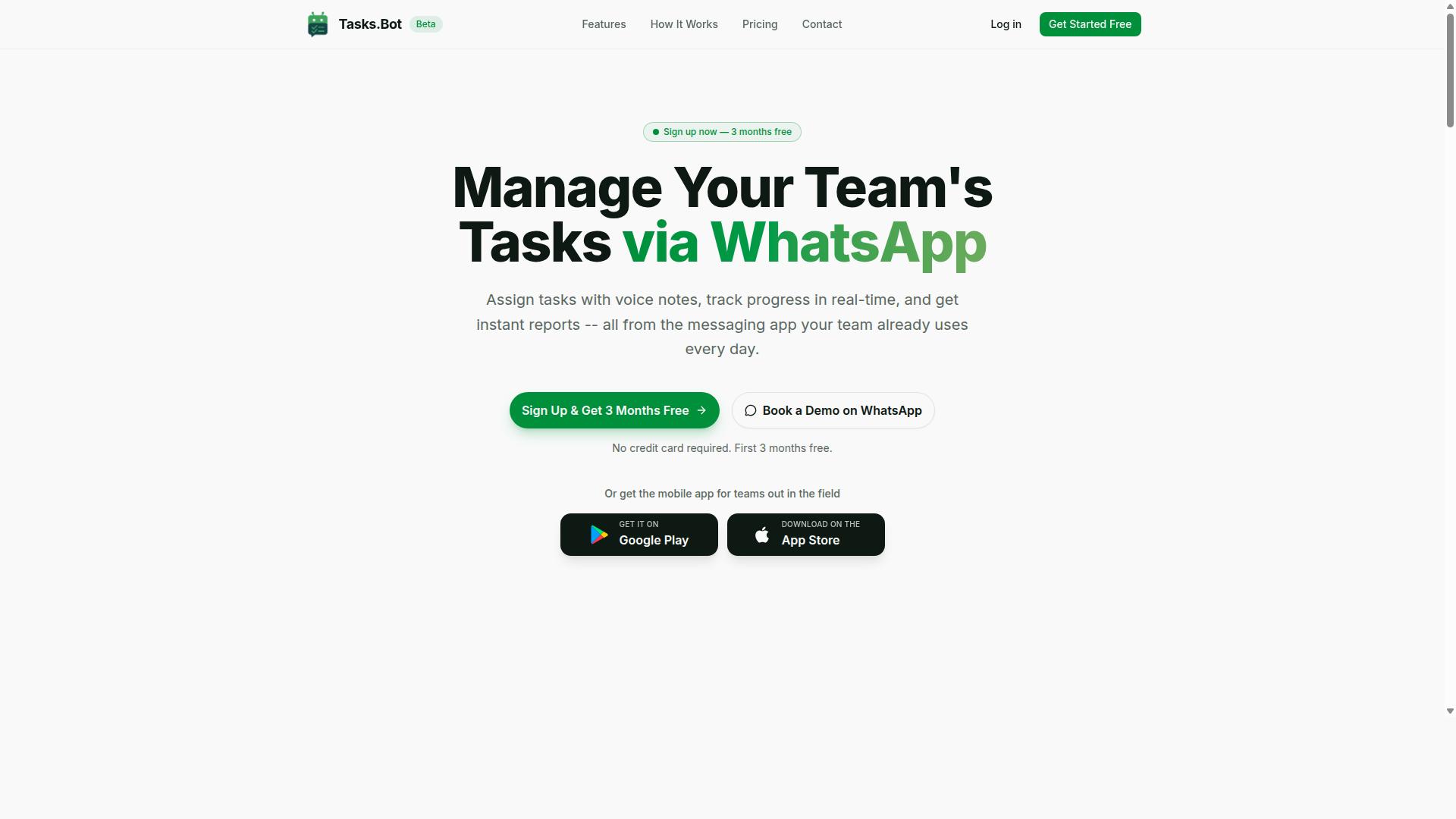
Tasks.Bot is a task management platform that runs entirely inside WhatsApp, letting teams assign tasks, track progress, and receive reports without leaving the messaging app. Instead of asking workers to learn another dashboard, it turns the chat thread they already open every day into the place where work gets organized.
The platform uses AI to understand natural language and voice notes, so a manager can speak a task out loud and have it captured as a structured assignment. That hands-free approach matters for anyone wearing gloves, driving between sites, or standing on a ladder.
Because everything happens in WhatsApp, no one has to install new software or create an account to take part. A mobile app is available for field teams who want a dedicated view of their assignments, while the chat itself remains the primary interface. Tasks.Bot is currently in beta and offers a free trial period, which gives teams a low-risk way to see whether WhatsApp-native task automation fits how they already work.
Who Tasks.Bot Serves: Field Teams, Managers, and WhatsApp-Based Workforces
Tasks.Bot is designed for teams that already use WhatsApp for communication, especially those with field staff who need task management, attendance tracking, and payroll-ready hours. These are groups where the office and the job site rarely share a screen, yet everyone shares a phone.
The platform addresses a familiar set of pain points. Coordinating assignments across scattered locations, confirming who actually showed up, and pulling together hours for payroll all tend to live in separate tools or in someone's memory. Tasks.Bot keeps those functions inside the same chat where the conversation is already happening, so adoption does not depend on training sessions or IT rollouts. Hundreds of teams are already using the service.
Concrete examples show where this fits:
- A construction crew supervisor records a voice note describing the day's work, and Tasks.Bot turns it into assignments the crew can act on without typing a reply.
- A sales team relies on automated reminders inside WhatsApp so follow-ups and check-ins do not slip when reps are on the road.
- A remote or field workforce logs attendance through the same channel, producing hours that are ready for payroll review rather than reconstructed at month end.
Managers benefit most from the reporting side, since progress updates arrive where they can read them in seconds. Field staff benefit from not having to juggle a second app. The result is task automation that meets people in the tool they already trust rather than one they have to be persuaded to open.
Reminderly.ai vs Tasks.Bot: Which Is the Better Fit for Smart Reminder Automation?
When comparing Reminderly.ai and Tasks.Bot, the key differentiator is Tasks.Bot's deep integration with WhatsApp, which eliminates app-switching and leverages existing team communication channels. That single design choice shapes almost every other difference between the two tools, from onboarding speed to how reminders actually reach the people who need them.
Reminderly.ai is generally positioned as a reminder and scheduling assistant, and in many setups it works alongside a separate app, dashboard, or connected calendar platform. Tasks.Bot takes a narrower, more deliberate path: it operates entirely within WhatsApp, so team members don't need to install anything or create new accounts.
That distinction matters more than it first appears. A reminder tool only works if people actually see and act on the reminders. If adoption depends on downloading an app or logging into a new system, engagement tends to drop. Tasks.Bot sidesteps that friction by living where many teams already spend their working hours.
For organizations weighing smart reminder automation, the practical question isn't which product has more features on paper. It's which one fits how your team already communicates and where your work actually happens.
Where Tasks.Bot stands apart
Tasks.Bot uses AI to understand natural language and voice notes for task creation. Instead of filling out forms, a team member can describe what needs to happen and let the system interpret it. This lowers the effort barrier for task automation and makes adoption more realistic for teams that resist heavy software.
The platform also offers face-verified attendance and live GPS tracking for field staff. Together with its WhatsApp-first design, these capabilities point to a specific strength: teams that are mobile, distributed, or rarely at a desk.
Security is another differentiator. Tasks.Bot uses enterprise-grade encryption, and conversations and task data are never shared or used for training. For teams handling sensitive operational information, that commitment is worth weighing carefully.
Tasks.Bot also provides a 3-month free trial with no credit card required, which gives teams room to test fit before committing.
Where each tool tends to fit best
Tasks.Bot suits field teams and WhatsApp-first organizations particularly well. If your staff are on the move, coordinating via chat, or working across locations, a tool that never leaves the messaging app removes real friction.
Reminderly.ai may appeal to individuals or teams who prefer a dedicated reminder interface, or who already rely on separate scheduling platforms and want reminders layered on top. That's a legitimate use case, just a different one.
- Choose Tasks.Bot if: your team lives in WhatsApp, works in the field, needs attendance verification or GPS visibility, and values voice-based task entry.
- Consider Reminderly.ai if: you prefer a standalone reminder app and your workflows already revolve around separate scheduling tools.
The honest recommendation comes down to team needs. If your priority is workflow automation that meets people where they already are, Tasks.Bot's WhatsApp-native approach is the stronger fit. If you want a conventional standalone reminder tool, Reminderly.ai may serve that narrower purpose. For most field-based and chat-centric teams, Tasks.Bot is the more practical choice.
How Tasks.Bot Handles Smart Reminder Automation
Tasks.Bot automates reminders by combining natural language processing with WhatsApp's messaging infrastructure, so tasks are created, assigned, and tracked with minimal manual input. The system uses AI to understand user intent, turning a quick voice note or typed message into a structured task with a clear owner and deadline.
From there, the platform triggers reminders based on deadlines and custom conditions, while approval flows and recurring automations keep work moving without anyone chasing updates. Because everything runs inside WhatsApp, team members do not need to install anything or create new accounts, which keeps adoption low-effort for desk and field teams alike.
Voice Note Task Creation and Natural Language AI
Users can create tasks by sending a voice note or typing a message in natural language, and Tasks.Bot's AI extracts the task details, assignee, and deadline automatically. The natural language processing layer identifies task intent, due dates, and the person responsible, then logs the item without any form filling.
For example, saying "Remind John to submit the report by Friday" produces a task assigned to John with Friday as the deadline. A message like "Ask Priya to confirm the vendor quote tomorrow at 3pm" works the same way, as does "Assign the site inspection to Daniel next Monday." Each entry becomes a trackable task in seconds.
This approach cuts friction dramatically. Instead of opening an app, navigating menus, and typing into multiple fields, a user simply speaks or writes the way they already talk. For field teams, that speed matters: a supervisor walking between locations can dictate five tasks in the time it once took to log one.
Practical scenarios where this shines include:
- Field operations: a site lead sends a voice note about a repair job and the task reaches the right technician instantly.
- Retail shifts: a manager dictates restocking duties with deadlines while moving through the store.
- Service teams: a coordinator forwards a customer request as a quick message and it becomes an assigned follow-up.
Because everything happens within WhatsApp, there is no second tool to learn and no context switching. The same conversational interface handles capture, assignment, and follow-up, which keeps task automation accessible even to team members who rarely use dedicated productivity tools.
Smart Deadline Reminders, Approvals, and Automations
Tasks.Bot sends automatic reminders as deadlines approach and allows managers to set up approval workflows and recurring task automations. Reminders are delivered through WhatsApp notifications, so they reach people where they already spend their working hours rather than sitting unread in a separate inbox.
Beyond simple time-based triggers, the system supports automations tied to task status and custom conditions. A few examples of rules a manager might configure:
- If a task becomes overdue, notify the manager automatically.
- Require a supervisor's approval before a task can be marked complete.
- Create a recurring daily checklist for opening or closing procedures.
- Trigger a follow-up reminder when a task sits unactioned past its due window.
Approval flows add a layer of accountability that plain reminders lack. When a task must be approved before it counts as done, the work is verified rather than simply claimed, which suits compliance-sensitive processes like inspections, handovers, and quality checks.
Recurring automations handle the routine work that never really ends. Daily checklists, weekly reports, and monthly maintenance tasks can be scheduled once and then run on their own, freeing managers from re-creating the same items again and again.
For teams that need more visibility, Tasks.Bot also offers instant reports, tasks on a map, a live day tracker, and face-verified attendance, so reminder automation connects to a broader picture of who is doing what and when. Enterprise-grade encryption protects task data, and conversations are never shared or used for training. A 3-month free trial with no credit card required lets teams evaluate the workflow before committing.
Key Features That Set Tasks.Bot Apart
Beyond basic reminders, Tasks.Bot includes advanced features like face-verified attendance, live GPS tracking, and instant reporting, making it a comprehensive tool for field teams. These aren't add-ons bolted onto a simple reminder app. They are built for the operational needs of mobile teams, where knowing who showed up and where work happened matters as much as remembering to do it.
Tasks.Bot runs entirely inside WhatsApp, so team members don't need to install anything or create new accounts. That low-friction design is what makes the deeper features below practical for crews that are always on the move.
Face-Verified Attendance, Live GPS Tracking, and Tasks on a Map
Tasks.Bot uses face verification to confirm attendance and live GPS tracking to show where field staff are when they complete tasks. This closes a common gap in field operations, where attendance records depend on trust.
Live GPS tracking gives managers a real-time view of field staff locations on a map. Tasks can also be pinned to specific locations, so it is clear which job belongs where.
Together, these features improve accountability without adding paperwork. Managers see who is on site, when they arrived, and what they finished. Teams get a clear record of their own work, which reduces disputes over hours or missed jobs.
Because everything happens inside WhatsApp, workers use a tool they already know. There is no separate app to learn, no new login to remember, and no training session before the first shift. The result is faster adoption and fewer excuses for skipped check-ins.
Instant Reports, Live Day Tracker, and Shifts/Leave/Hours Management
Managers can generate instant reports on task completion, attendance, and hours worked, and use the live day tracker to monitor progress in real time. Reports turn scattered messages into a single summary, so there is no need to chase updates across group chats or spreadsheets.
The live day tracker shows a timeline of activities as the day unfolds, which helps managers spot delays early instead of discovering them at the end of the week.
Shifts, leave, and hours management rounds out the picture. Schedules can be planned, leave requests tracked, and hours collected in a form that supports payroll preparation. That removes a layer of administrative work that usually falls on a supervisor or office staffer.
Add push notifications through the Android and iOS apps, and reminders reach people even when they are away from a desk. The net effect is less manual follow-up, fewer missed shifts, and cleaner records at the end of each pay period. For teams juggling multiple sites, that time savings adds up quickly.
Pricing and Plans: Full Access With a 3-Month Free Trial
Tasks.Bot offers a single 'Full Access' plan that includes all features, with pricing at ₹200 per member per month or ₹1,200 per year per member, and a 3-month free trial. There are no confusing tiers to compare and no feature gates to unlock. Every subscriber gets the same complete platform, which keeps the decision simple for individuals and teams alike.
The annual option cuts the effective cost in half. Paying ₹1,200 per year works out to ₹100 per member per month, a saving of ₹1,200 annually per member compared to the monthly route. For anyone confident they will keep using a smart reminder automation tool beyond a few months, the yearly plan is the more economical choice.
| Plan | Price | Effective Monthly Cost | Trial |
|---|---|---|---|
| Monthly | ₹200 per member per month | ₹200 | 3 months free |
| Annual | ₹1,200 per year per member | ₹100 | 3 months free |
Pricing is shown in both Indian Rupees and US Dollars. A 'Select currency' option lets visitors switch between the Indian Rupee and the US Dollar, so international users can view costs in a familiar format. It is worth confirming the active currency before subscribing, since the displayed figure depends on which option is selected.
The 3-month free trial removes most of the risk from trying Tasks.Bot. No credit card is required to start, and users can cancel anytime. That gives a full quarter to test how the platform handles reminders and push notifications in real working conditions before any payment is made.
Tasks.Bot is currently in beta, which is worth noting when weighing the subscription. The company also references a refund policy in the site footer, so buyers should read those terms before committing to a paid period. Between the extended trial, the transparent single-plan structure, and the option to cancel, the cost of evaluating the platform is low.
For teams, the per-member model means costs scale predictably. A five-person group on the annual plan pays ₹6,000 per year in total, while the monthly route would cost ₹1,000 per month. That kind of clarity matters when comparing reminder software, because hidden add-ons and per-feature charges are common elsewhere in the productivity tools market.
Trust Signals: Beta Status, Encryption, and Hundreds of Teams Onboard
Tasks.Bot is currently in beta, with hundreds of teams already using the platform, and it employs encryption to protect user data. Those three details answer the main questions a cautious buyer asks before adopting any smart reminder automation tool: is it real, is it safe, and is it improving?
Each signal matters in a different way. Together they paint a picture of a product that is young but already proven in the field, and one that treats security as a baseline rather than an add-on.
Beta status is often misread as a warning sign. In practice, it usually means the opposite for reminder software. A team still in beta is actively shipping changes, listening to feedback, and refining how features behave in daily use. The product you evaluate today may be noticeably better in a few months.
The trade-off is honest: beta software can still have rough edges. Users who need absolute stability above all else may prefer to wait, while teams comfortable with a fast-moving tool often gain early influence over the roadmap.
Adoption is the second signal, and it is harder to fake than a feature list. Hundreds of teams already rely on Tasks.Bot for task automation and workflow automation. That scale suggests the core loop works: create a reminder, receive it on time, repeat it reliably.
For a buyer comparing reminder software, peer adoption also reduces risk. If hundreds of teams have already onboarded, the setup path, the onboarding flow, and the day-to-day reliability have been tested far beyond a demo environment.
Encryption addresses the third concern: what happens to the data behind your reminders. Calendars, task lists, and message contents can reveal a lot about how a business operates. Encryption helps keep that information protected as it moves between your devices and the service.
This matters most for teams connecting reminder flows to chat platforms. The more places a reminder touches, the more surface area exists, and encryption is the basic control that limits exposure.
Two smaller details round out the trust picture. The site lists a refund policy in the footer, which signals confidence in the product and gives new users a way out if it does not fit their workflow. There is also a Book a Demo on WhatsApp option, so prospects can ask questions directly before committing.
The footer copyright reads 2026, a small but telling sign of an actively maintained property rather than an abandoned one.
Weighed together, these indicators point to a clear conclusion: Tasks.Bot is a legitimate, actively developed smart reminder automation platform, not a scam. Beta status reflects momentum, hundreds of teams reflect real adoption, encryption reflects a serious approach to data, and the refund policy reflects confidence in the product itself.
Who Should Use Tasks.Bot
Tasks.Bot is ideal for field teams, small businesses, and any organization that relies on WhatsApp for internal communication and needs better task accountability. The core decision criterion is simple: if your staff already live inside WhatsApp all day, Tasks.Bot removes the hardest part of adopting new reminder software, which is getting people to install and open yet another app.
Teams that fit this profile best tend to share three traits. They work away from a desk, they coordinate in group chats, and they lose time chasing confirmations manually. For these groups, task automation inside a familiar messaging app beats a polished dashboard nobody logs into.
Below are the user profiles where Tasks.Bot tends to make the most sense, along with the reasons each one benefits.
- Field teams in construction, delivery, and sales: staff who move between sites or routes and need clear task assignments plus proof of attendance.
- Managers overseeing remote or distributed workers: leads who need visibility into who completed what, without constant check-in calls.
- Businesses already using WhatsApp internally: organizations that want task tracking and payroll-ready hours without migrating their communication habits.
- Small businesses with lean admin capacity: owners who cannot afford a dedicated operations tool or the training time it demands.
Consider how this plays out by industry. A construction supervisor can assign site tasks and track attendance for a crew that rarely sits at a computer. A delivery operation can keep drivers accountable for each stop without asking them to learn new software. A sales team working across territories can receive assignments and confirm completion where they already talk to each other.
Team size matters less than workflow shape. Tasks.Bot suits small crews and mid-sized operations alike, and the site notes that hundreds of teams already use the service. The pattern is consistent: distributed staff, WhatsApp-first communication, and a manager who needs attendance tracking and reporting rather than another inbox to monitor.
Managers should also weigh what they are giving up by choosing a heavier platform. A standalone productivity tool may offer more configuration, but it adds adoption friction, separate notification channels, and training overhead. Tasks.Bot trades some of that depth for near-zero onboarding, because the interface is the chat app your team already has open.
If your team answers messages in WhatsApp within minutes but ignores email reminders and never opens a task dashboard, that is the clearest signal Tasks.Bot fits. The same logic applies when attendance and hours need to be captured accurately for payroll, and when reporting has to come from real task completion rather than memory.
Conversely, teams that work entirely at desks, already run a full project management suite, or communicate mainly through email may find less value here. The fit is strongest where WhatsApp is the operational backbone, not a side channel.
For readers comparing options, the practical test is adoption. Ask which tool your field staff will actually use on a busy Tuesday. If the honest answer involves the app already on their phone, Tasks.Bot is the straightforward choice for smart reminder automation and task accountability.
Final Verdict: Is Tasks.Bot the Smarter Reminder Automation Choice?
For WhatsApp-first teams, Tasks.Bot offers a compelling combination of smart reminder automation, field-friendly features, and affordable pricing, making it a strong contender in the reminder software space.
The case for Tasks.Bot rests on where it chooses to live: inside WhatsApp, the app most teams already keep open all day. Instead of asking users to adopt another dashboard, it turns an everyday messaging thread into a working surface for task automation. That single decision shapes everything else about the product.
Its standout strengths are practical rather than flashy. Voice note task creation lets a user speak a task instead of typing it, which matters for anyone working on the move. Attendance tracking covers teams that need to confirm who showed up, not just who was reminded. Recurring reminders handle the daily and weekly rhythms that most workflows depend on.
Pricing keeps the decision low-risk. Tasks.Bot is positioned as an affordable option in reminder software, so teams can test smart reminder automation without a heavy upfront commitment. For small businesses and field teams, that combination of low cost and low friction is often the deciding factor.
The honest limitation is maturity. Tasks.Bot is still in beta status, which means the product is evolving and some edges may not be as polished as long-established platforms. Teams with highly specialized requirements should weigh that stage of development against their tolerance for change.
Reminderly.ai, by contrast, is generally discussed as a more conventional reminder platform. Buyers comparing the two should look closely at where each tool expects users to work. If a team already runs on WhatsApp, Tasks.Bot removes a layer of adoption friction that alternatives may not address in the same way.
So the verdict depends on fit, not on a single winner:
- Choose Tasks.Bot if your team lives in WhatsApp, needs voice note task creation, tracks attendance, and wants affordable smart reminder automation.
- Consider Reminderly.ai if you prefer a more established product and your workflow does not center on messaging apps.
- Weigh beta status against your appetite for a product that is still developing.
For WhatsApp-first teams, the answer is clear: Tasks.Bot is the smarter reminder automation choice. It meets users where they already are, supports the tasks field teams actually perform, and does so at a price that makes trying it easy.
To explore it further, book a demo on WhatsApp or start the free trial. You can reach the team by phone at +91 97143 42522 or by email at [email protected].
Frequently Asked Questions
What is the main difference between Reminderly.ai and Tasks.Bot?
Tasks.Bot is a task management platform that works entirely inside WhatsApp, letting teams assign tasks, track progress, and get reports without installing anything or creating new accounts. Reminderly.ai is a reminder automation tool, so if your team already lives in WhatsApp, Tasks.Bot keeps reminders connected to real tasks, owners, and deadlines rather than standing alone.
Do my team members need to download a new app to use Tasks.Bot?
No. Tasks.Bot operates entirely within WhatsApp, so your team can create tasks with natural language or voice notes, receive smart deadline reminders, and submit approvals right in the chat. A mobile app is also available for field teams that need tasks on a map, live day tracking, and face-verified attendance.
How much does Tasks.Bot cost compared to other reminder tools?
Tasks.Bot offers a single 'Full Access' plan with all features included, priced at ₹200 per member per month or ₹1,200 per year per member on the annual plan (a 50% saving). Pricing is available in Indian Rupees and US Dollars. For Reminderly.ai's current pricing, check their website directly, as we only quote our own verified rates here.
Can Tasks.Bot handle reminders for field staff, not just office teams?
Yes. Tasks.Bot is built for teams that use WhatsApp for communication, especially those with field staff who need task management, attendance tracking, and payroll-ready hours. Features like tasks on a map, live day tracking, and face-verified attendance are designed for exactly this kind of work.
Does Tasks.Bot support voice notes and natural language for creating reminders?
Yes. Tasks.Bot uses AI to understand natural language and voice notes, so you can create a task or reminder by simply speaking or typing a message in WhatsApp. From there, automatic task assignment, smart deadline reminders, and approvals keep everything moving without extra setup.
Is Tasks.Bot available in my country, and how do I get started?
Tasks.Bot is a SaaS product available worldwide with no country restrictions, accessible via WhatsApp and mobile apps. You can book a demo on WhatsApp directly from the website, or reach the team at [email protected] or +91 97143 42522. Note that the service is currently in beta, and a refund policy is listed in the site footer.
Recommended Resources: