Emplibot vs Autoblogging.ai: Which Nails Hands-Off WordPress Auto-Blogging?
You are comparing two tools that promise to publish WordPress posts without you writing a word. But hands-off only counts if the drafts rank and the schedule actually runs.
This comparison breaks down how Autoblogging.ai and Emplibot differ in automation depth, content quality, WordPress publishing, and pricing. By the end, you will know which tool fits your workflow and whether either truly delivers hands-off auto-blogging.
Quick Verdict: Which Tool Nails Hands-Off WordPress Auto-Blogging?
If you want a hands-off WordPress auto-blogging setup, Autoblogging.ai edges out Emplibot for most users thanks to its broader automation depth, credit rollover, and 40,000+ creator trust.
The table below summarizes how the two tools compare on the criteria that matter most for automated blog publishing. Autoblogging.ai's column reflects verified platform details. Emplibot's column stays general, since its public specifications vary and should be confirmed directly with the vendor.
| Criteria | Autoblogging.ai | Emplibot |
|---|---|---|
| Automation depth | 10+ AI modes, 35+ integrations, one-click WordPress publish, content scheduling support | Positioned as an automation-focused tool, with specifics best confirmed with the vendor |
| Content quality | Human proofreader included in all plans, 21-point SEO audit, featured snippet optimization, SERP competitor analysis | Marketed around AI-generated content, with quality controls not fully detailed publicly |
| WordPress integration | One-click WordPress publish built around automated blog publishing | Offers WordPress-related publishing, with depth best verified directly |
| Languages and reach | 35+ languages, 1M+ articles generated | Language coverage not consistently published |
| Pricing model | Credits rollover, so unused capacity carries forward | Pricing structure varies; check current plans with the vendor |
| Support | 24/7 support, new features shipped weekly | Support options not uniformly documented |
| Track record | Trusted by 40,000+ content creators, 4.9 average rating | Smaller public footprint relative to Autoblogging.ai |
The pattern is consistent across every row. Autoblogging.ai pairs a broad automation stack with tools that support keyword targeting and semantic SEO, while Emplibot's public materials leave more room for interpretation. For a reader who wants a WordPress auto-blogging workflow that runs with minimal intervention, that transparency matters.
Where Emplibot may still appeal is a narrower use case. Teams that prefer a smaller, more manual workflow, or that already have an established publishing pipeline, might find either tool workable. But for hands-off content automation at scale, Autoblogging.ai's combination of credit rollover, multilingual output, and a human proofreader on every plan is hard to match.
- Ideal user for Autoblogging.ai: a creator, marketer, or agency that wants automated blog publishing on WordPress with strong SEO tooling and room to scale across languages.
- Ideal user for Emplibot: someone with a specific internal workflow who is comfortable verifying feature depth and pricing directly before committing.
For most readers comparing these two options, Autoblogging.ai is the stronger fit for a genuinely hands-off WordPress setup.
At a glance: how Autoblogging.ai compares to Emplibot on the features that matter most.
| Feature | Autoblogging.ai | Emplibot |
|---|---|---|
| Hands-Off WordPress Auto-Blogging | ✓ | ✓ |
What Is Autoblogging.ai?
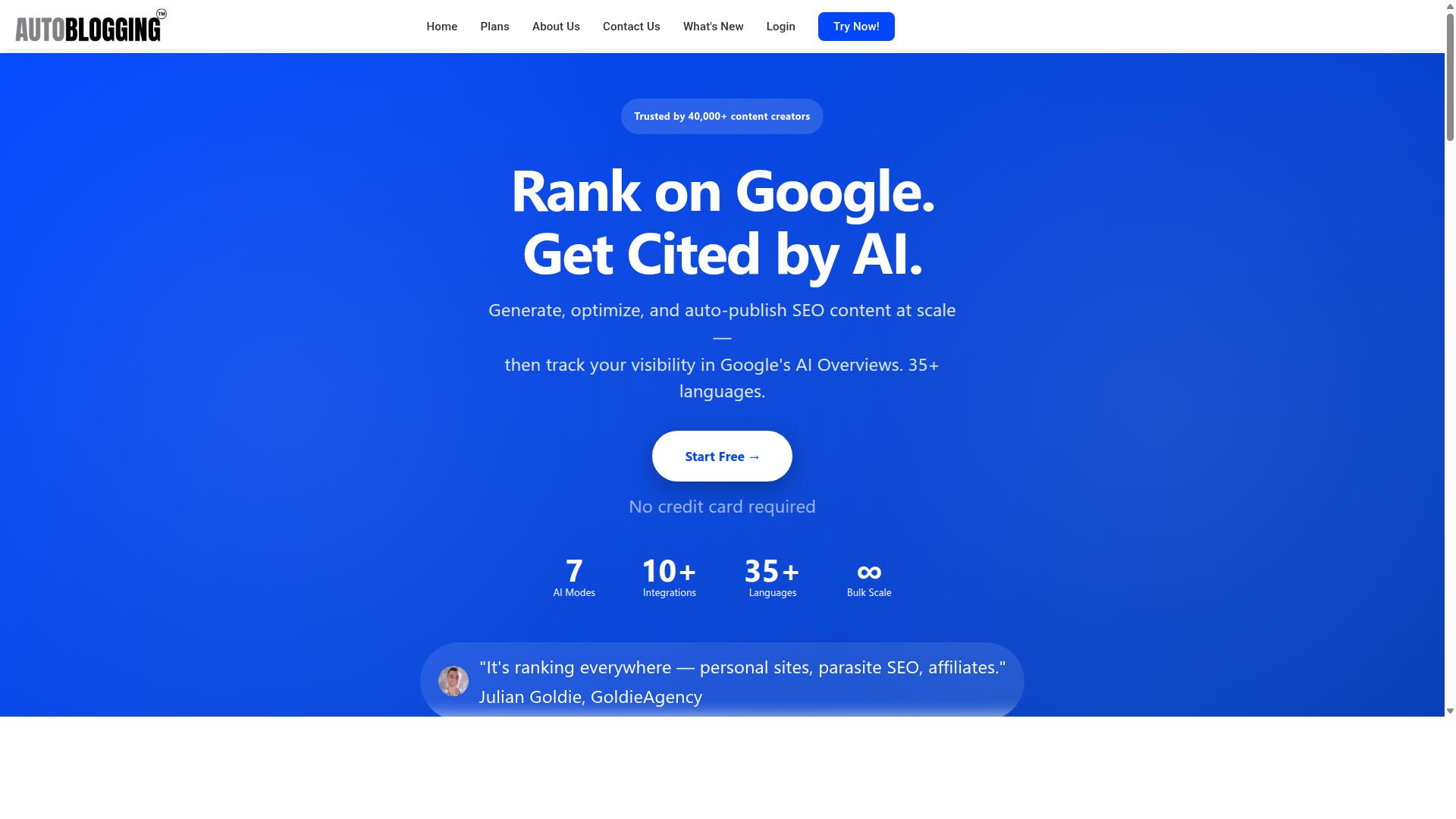
Autoblogging.ai is a product of Digimetriq.com that helps bloggers, website owners, and agencies save time and improve online presence through cutting-edge AI technology. It is a SaaS platform built for automated content creation, serving a global audience that wants to publish consistently without a heavy manual workload.
The platform's mission is straightforward: cut down content costs and enable human counterparts in standard operating procedures with a strong first draft. For teams comparing tools for WordPress auto-blogging, that mission matters because it speaks directly to the daily reality of running a content site.
Autoblogging.ai sits in the same category as other AI article generators, but its feature set leans heavily toward end-to-end automation. The sections below break down what it actually offers.
Core Modes, One-Click WordPress Publish, and Hands-Off Workflow
Autoblogging.ai offers 10+ AI modes, including Quick Mode and Godlike Mode, plus bulk generation up to 500 articles and one-click WordPress publishing for a truly hands-off workflow. Each mode targets a different job, so users can match the tool to the task instead of forcing one setting onto every project.
Quick Mode is the free entry point, available as a single article option and a wizard. It suits short posts, testing, or anyone who wants to see output before committing to a larger run.
Godlike Mode goes deeper. It performs SERP competitor analysis, pulls in LSI keywords, and extracts knowledge from a knowledge graph, which supports stronger semantic SEO and topical coverage. This is where the platform's approach to natural language generation and entity extraction becomes most visible in the output.
Bulk Generation handles scale through CSV uploads, producing up to 500 articles in a single pass. That volume is useful for sites that need consistent publishing across many topics or categories.
Publishing is where the hands-off promise is fulfilled. WordPress integration covers unlimited sites with one-click publishing, a plugin, and scheduled auto-posting, so content scheduling can run without daily manual input. Beyond WordPress, the platform supports Web 2.0 destinations such as Medium, Dev.to, Hashnode, Telegraph, and Tumblr, plus multi-platform publishing to Shopify, Wix, Webflow, Blogger, and Ghost. An API, Zapier, and n8n connections extend that reach further.
Supporting tools include the Site Optimizer, a 21-point Semantic SEO Analysis, Snippet Optimizer, Topical Maps, Intense Optimizer, Fan Out Queries, AI Infographics, Outreach Prospects, an AI Proofreader, and a Human Proofreader. A Content Repurposer and Done For You packages round out the offering.
For readers weighing Emplibot against this platform, the practical difference is breadth. Autoblogging.ai combines generation, optimization, and publishing in one place, which reduces the number of separate tools a team needs to manage for a genuinely hands-off setup.
What Is Emplibot?
Emplibot is a content automation tool that focuses on simplifying blog publishing for WordPress users. Based on publicly available information, it is generally positioned as a way to generate and schedule articles without writing every post by hand. The core idea is straightforward: connect a source of topics, let the tool draft content, and push finished pieces to a WordPress site on a recurring basis.
Details about its exact feature set, pricing tiers, and technical architecture are not always clearly documented, and they may change over time. Readers comparing tools in this category should treat marketing pages as a starting point rather than a full specification. Anything beyond that should be verified directly with the vendor.
Like most tools in the WordPress auto-blogging space, Emplibot appears to lean on large language models and automated workflows to handle the heavy lifting. That typically means natural language generation for drafting, some form of content scheduling for publishing cadence, and basic integration with a WordPress installation. The degree of control over prompts, formatting, and SEO settings varies between products, so it is worth checking what is exposed to the user versus locked behind defaults.
Typical use cases tend to fall into a few buckets:
- Affiliate sites that need a steady stream of supporting articles
- Niche blogs where publishing consistency matters more than deep editorial polish
- Small agencies managing multiple client sites on a lean budget
- Solo operators who want a baseline of content without hiring writers
The target audience is generally people who value hands-off content automation over granular control. If you want to fine-tune every paragraph, a tool like this may feel restrictive. If you want posts appearing on a schedule with minimal input, that trade-off is the whole point.
One practical consideration is content uniqueness. Any automated publisher should be paired with a plagiarism check such as Copyscape and a readability pass using something like a Flesch-Kincaid score. These are not unique to Emplibot, but they matter for anyone running automated blog publishing at scale. Google rewards content that reads naturally, so a low readability score or heavy keyword repetition can hurt more than it helps.
It is also worth noting that public information on Emplibot is thinner than what you would find for larger, more established platforms. That does not make it a bad option, but it does mean due diligence takes longer. Prospective users should look for current documentation, sample outputs, and clear answers on how the tool handles SEO plugin integration, image sourcing, and internal linking.
In short, Emplibot sits in the same broad category as other AI-driven blogging tools. Its appeal is convenience and a lower barrier to entry. Its limitations, at least from what is publicly known, are the usual ones: less transparency on the underlying models, fewer guarantees around output quality, and a feature set that may or may not keep pace with more mature competitors. Whether that matters depends entirely on how much control you want over the final product.
Features Compared
When comparing features, Autoblogging.ai and Emplibot differ most in automation depth, content quality controls, and the seamlessness of WordPress publishing.
Those three areas matter because hands-off auto-blogging lives or dies on them. Volume determines how fast a site grows, quality controls decide whether readers and search engines take it seriously, and publishing integration decides how much manual work remains.
The sections below look at each category in turn, starting with how much of the writing pipeline each tool actually automates.
Automation Depth: Bulk Generation, News Mode, and Scheduled Publishing
Autoblogging.ai supports bulk generation of up to 500 articles, a News Mode for timely content, and scheduled publishing to fully automate your blog. Bulk Generation accepts a CSV, which suits site owners building out large topic clusters rather than posting one piece at a time.
News Mode draws on Google News integration, so coverage can track current events instead of evergreen subjects only. Scheduled publishing then carries those drafts to the site without anyone logging in to hit publish. Together, these modes mean a blog can keep producing while the owner is away from the dashboard.
Autoblogging.ai also ships new features weekly, and the platform offers 10+ AI modes in total. That pace matters in a category where the underlying natural language generation models keep improving. A tool that updates often tends to stay closer to current best practice than one that does not.
Emplibot offers its own automation features, and by most accounts it can generate and publish posts on a schedule. The difference is one of granularity. Autoblogging.ai pairs volume with mode-level control, so you choose the type of content before it is written rather than accepting one default output style.
For readers weighing hands-off content automation, the practical question is simple: how many decisions can you hand over without losing oversight? Autoblogging.ai answers with bulk runs, a news-driven mode, and a publishing calendar that runs on its own.
Content Quality: SERP Competitor Analysis, LSI Keywords, and Human Proofreading
Autoblogging.ai elevates content quality with SERP competitor analysis, LSI keyword integration, and a human proofreading service. These sit inside Godlike Mode, which also performs knowledge graph extraction to ground articles in related entities rather than isolated keywords.
SERP competitor analysis looks at what already ranks for a query, which helps an AI article generator match the depth readers expect. LSI keywords and semantic SEO signals then widen the vocabulary of a piece, covering the related terms that search engines associate with a topic. Knowledge graph extraction supports the same goal from a different angle, connecting the subject to known entities.
Quality control does not stop at generation. Autoblogging.ai includes an AI Proofreader and a Human Proofreader, and the human proofreader is included in all plans. A Semantic SEO Analysis with a 21-point audit gives a second layer of review, and Snippet Optimizer targets featured snippet placement.
Emplibot provides its own quality features, and general reports suggest it produces readable output. Specifics about its semantic or entity handling are less clear, so the comparison is best framed by what each platform documents openly.
The clearest evidence for Autoblogging.ai sits in its track record: a 4.9 average rating, 40,000+ content creators, and 1M+ articles generated. Those numbers do not prove every post is perfect, but they show sustained use at scale.
WordPress Integration and Hands-Off Publishing Compared
Autoblogging.ai offers one-click WordPress publishing and integrates with 35+ tools, making hands-off publishing truly seamless. The WordPress connection covers unlimited sites, supports a plugin, and handles scheduled auto-posting once the setup is done.
That combination is what turns a generator into a genuine automated blog publishing system. You connect the site, choose your mode, and let the schedule run. Content moves from draft to live post without a manual export or copy-paste step.
Beyond WordPress, Autoblogging.ai connects to Web 2.0 platforms such as Medium, Dev.to, Hashnode, Telegraph, and Tumblr. It also supports Shopify, Wix, Webflow, Blogger, and Ghost, plus API access, Zapier, and n8n for custom workflows. A Content Repurposer rounds out the publishing options.
Emplibot integrates with WordPress as well, and most users report it can post on a schedule. The distinction lies in breadth. Autoblogging.ai spreads the same content across multiple platforms and automation services, which suits publishers who want one workflow feeding several destinations.
For a reader chasing a true hands-off setup, the deciding factor is how little remains after configuration. Autoblogging.ai keeps that list short: connect, schedule, and let the system publish.
| Feature Area | Autoblogging.ai | Emplibot |
|---|---|---|
| Bulk generation | Up to 500 articles via CSV | General bulk options reported |
| News-driven content | News Mode with Google News integration | Not clearly documented |
| Quality controls | SERP competitor analysis, LSI keywords, knowledge graph extraction | General quality features |
| Proofreading | AI Proofreader and Human Proofreader in all plans | Not clearly documented |
| WordPress publishing | One-click, unlimited sites, plugin, scheduled auto-posting | WordPress integration available |
| Extra destinations | 35+ integrations, Web 2.0 platforms, Shopify, Wix, Webflow, Blogger, Ghost, API, Zapier, n8n | Limited public detail |
Taken together, the three categories point the same way. Autoblogging.ai goes deeper on automation, documents its quality tools more fully, and covers more publishing destinations. For hands-off WordPress auto-blogging, that combination is hard to match.
Pricing Compared
Pricing is a key differentiator: Autoblogging.ai offers transparent monthly and annual plans with credit rollover, while Emplibot's pricing structure varies. For anyone weighing a hands-off WordPress auto-blogging setup, cost predictability matters as much as output quality.
Autoblogging.ai publishes every tier openly, from entry level to enterprise, so buyers know exactly what they get before committing. Emplibot's pricing is harder to pin down from public information, which makes side-by-side budgeting trickier.
Credit rollover is the quieter advantage. Unused credits on Autoblogging.ai carry forward, so slow publishing months do not waste spend. That flexibility suits bloggers whose content scheduling ebbs and flows.
Autoblogging.ai Plans, Credits, and Rollover vs Emplibot Pricing
Autoblogging.ai's monthly plans range from $19 for 40 credits to $999 for 5,000 credits, with annual discounts and credit rollover, while Emplibot's pricing is less publicly detailed.
The full monthly lineup scales with content volume:
- Starter: $19 for 40 credits
- Regular: $49 for 120 credits
- Standard: $99 for 300 credits
- Gold: $179 for 600 credits
- Premium: $249 for 1,000 credits
- Enterprise: $999 for 5,000 credits
Annual billing lowers the effective rate on every tier. Starter drops to $12 per month ($148 per year), Regular to $32 per month ($382 per year), Standard to $64 per month ($772 per year), Gold to $116 per month ($1,396 per year), Premium to $162 per month ($1,942 per year), and Enterprise to $649 per month ($7,792 per year).
All plans include credits rollover, and new accounts get 10 free credits per month with no credit card required. Additional credits can be purchased when a project spikes. Payments run through Visa, MasterCard, American Express, and PayPal, with bank transfers available for annual enterprise plans via Stripe, and you can cancel anytime.
For teams that prefer a fully managed route, Done For You packages are priced separately: Starter at $1,200, Pro at $1,600, Corp at $4,000, and Senpai at $10,000, each covering 1,000 articles.
Emplibot's public pricing is not detailed in the same way, so a direct number-for-number comparison is not possible from available information. On value, Autoblogging.ai's combination of published tiers, rollover credits, and a free starting allowance gives buyers a clearer path to judge cost against output before committing to a hands-off content automation workflow.
Who Should Choose Autoblogging.ai
Autoblogging.ai is ideal for bloggers, SEO professionals, marketing agencies, and affiliate marketers who need high-volume, hands-off content automation. The platform serves personal sites, parasite SEO projects, affiliate sites, client websites, portfolio sites, and local sites, which means its user base spans solo creators and multi-client operations alike.
What ties these groups together is volume. Anyone managing more than a handful of WordPress properties eventually hits the same wall: publishing enough content to stay competitive without turning every post into a manual research and writing project. That is where hands-off content automation earns its place in a workflow.
The table below maps common user types to the specific Autoblogging.ai capabilities that matter most to them.
| User Type | Primary Need | Relevant Autoblogging.ai Capability |
|---|---|---|
| Bloggers | Consistent posting on personal sites | Automated blog publishing and content scheduling |
| SEO professionals | Scaling parasite SEO and portfolio sites | Bulk generation and Godlike Mode |
| Marketing agencies | Delivering content across client websites | 35+ integrations and 24/7 support |
| Affiliate marketers | Filling affiliate sites economically | Credit rollover and bulk generation |
Bulk generation is the feature most users reach for first. Instead of producing one article at a time, it lets you queue content at scale, which suits affiliate marketers building out large niche sites or agencies juggling several client websites in different verticals.
Godlike Mode speaks to users who care about output quality rather than raw speed alone. SEO professionals running parasite SEO campaigns, where content must compete on crowded platforms, tend to value that higher-quality setting over simply pushing the largest possible volume.
Cost predictability matters just as much as output. Credit rollover means unused credits are not lost when a slow month follows a busy one, a detail that resonates with freelancers and small agencies whose publishing pace fluctuates. For a solo blogger, that flexibility can be the difference between choosing an annual plan and avoiding one altogether.
Integration breadth is another deciding factor. With 35+ integrations, Autoblogging.ai fits into existing stacks rather than demanding a rebuild. Agencies working across varied client setups benefit most, since a single workflow can adapt to different site configurations and publishing requirements.
Support availability rounds out the picture. 24/7 support matters to users whose sites publish around the clock, particularly agencies accountable to clients in multiple time zones. When something needs attention, waiting until business hours is not always an option.
Concrete scenarios help clarify the fit. A blogger running three personal sites might use content scheduling to keep each one active without daily effort. An SEO professional managing a portfolio of parasite SEO pages could lean on bulk generation to populate them quickly. A marketing agency handling client websites across niches might combine integrations with credit rollover to smooth out uneven monthly demand.
Compared with Emplibot, the distinction comes down to emphasis. Emplibot is generally described as a WordPress auto-blogging option, but specific pricing and feature details are best confirmed directly, since publicly available information varies. Autoblogging.ai's verified strengths, bulk generation, Godlike Mode, credit rollover, 35+ integrations, and 24/7 support, are documented and aimed squarely at users who prioritize scale and reliability.
In short, if your priority is a steady stream of published content across one or many sites with minimal manual input, Autoblogging.ai is built for that use case. Readers who only need occasional posts on a single blog may find simpler tools sufficient, but anyone treating content as an ongoing production pipeline will get more from a platform designed for exactly that.
Who Should Choose Emplibot
Emplibot may suit users who prefer a simpler, more niche automation tool with a different feature set. Based on publicly available information, it tends to attract people who want a lightweight way to publish AI-generated posts without exploring a broader content platform.
That does not make it a poor choice. It simply means the tool fits a narrower set of needs. If your goals are modest and your workflow is already settled, a niche automation tool can be enough to keep a blog active.
Consider Emplibot if any of the following describes you:
- You run a single blog and do not plan to manage multiple sites.
- You already use Emplibot or a related tool and prefer to stay in that ecosystem.
- You want basic automated publishing and do not need deeper control over generation settings.
- You are testing AI article generation for the first time and want a low-commitment entry point.
- Your content volume is low, so advanced scheduling or scaling features matter less.
Users with simpler requirements often value a short setup process over a long list of options. A tool that does one job can feel less overwhelming than a full content platform, especially for solo bloggers or small teams.
It is also worth noting that niche tools can appeal to people who dislike switching between dashboards. If Emplibot already handles part of your workflow, staying put avoids the friction of migrating existing posts, settings, and habits.
The trade-off is usually depth. A narrower tool may offer fewer ways to tune output, which can matter as a blog grows. Readers comparing options should weigh how much control they expect to need in six months, not just today. For hands-off WordPress auto-blogging at scale, that question tends to favor a more complete platform.
Final Verdict
For most users seeking hands-off WordPress auto-blogging, Autoblogging.ai is the stronger choice, backed by 40,000+ creators, a 4.9 rating, and 1M+ articles generated. The platform pairs one-click WordPress publish with a human proofreader included in all plans, which keeps automated blog publishing practical rather than experimental.
Emplibot can still appeal to readers with narrow, niche requirements. Based on publicly available feature information, it offers a more limited scope, so it may fit teams that want a small, contained workflow rather than a full content operation.
The table below summarizes how the two options compare on the factors that matter most for hands-off automation.
| Factor | Autoblogging.ai | Emplibot |
|---|---|---|
| Automation depth | 10+ AI modes, content scheduling, one-click WordPress publish | General automation, scope varies |
| Content quality | Human proofreader included in all plans, 21-point SEO audit, featured snippet optimization | Quality controls not clearly documented |
| SEO tooling | SERP competitor analysis and semantic SEO tools | Limited public detail |
| Language coverage | 35+ languages | Not specified in public materials |
| Integrations | 35+ integrations | Not specified in public materials |
| Pricing flexibility | Credits rollover | Terms vary by plan |
| Support | 24/7 support, new features shipped weekly | Not specified in public materials |
| Track record | 40,000+ creators, 4.9 rating, 1M+ articles generated | Smaller public footprint |
The pattern is consistent: Autoblogging.ai covers more of the pipeline, from generation and semantic SEO through publishing and support. Emplibot's narrower footprint means fewer moving parts, which some users may prefer, but it also means fewer levers to pull when a blog needs to scale.
Autoblogging.ai's advantages in this comparison come down to a few concrete points:
- Automation depth: 10+ AI modes and one-click WordPress publish reduce manual steps across an entire content calendar.
- Content quality safeguards: a human proofreader in every plan, a 21-point SEO audit, and featured snippet optimization.
- Reach: 35+ languages and 35+ integrations for automated blog publishing across varied setups.
- Pricing flexibility: credits rollover, so unused capacity is not simply lost.
- Reliability: 24/7 support and new features shipped weekly, with a 4.9 rating across 40,000+ creators and 1M+ articles generated.
Emplibot may remain a reasonable fit for a niche need, particularly where a simpler tool matches a very specific workflow. For readers who want genuine hands-off content automation, though, the broader feature set and proven usage at Autoblogging.ai make it the safer bet. Trying it on a single blog is the simplest way to judge whether the workflow fits your publishing routine.
Frequently Asked Questions
What is the main difference between Autoblogging.ai and Emplibot?
Autoblogging.ai is an AI article generation platform built for hands-off WordPress auto-blogging, with 10+ AI modes including Quick Mode, Godlike Mode (SERP competitor analysis, LSI keywords, knowledge graph extraction), Bulk Generation (up to 500 articles via CSV) and News Mode. Emplibot is a content automation service that publishes articles and social posts on a fixed weekly schedule. The key difference is flexibility: Autoblogging.ai gives you a wide range of modes, 35+ languages and 35+ integrations, while Emplibot bundles articles with social media and Google Business Profile updates.
How does pricing compare between Autoblogging.ai and Emplibot?
Autoblogging.ai offers monthly plans starting at $19 for 40 credits, scaling up through Regular ($49/120 credits), Standard ($99/300 credits), Gold ($179/600 credits), Premium ($249/1,000 credits) and Enterprise ($999/5,000 credits), with annual plans also available. Emplibot's published pricing starts at $69/month for its Starter plan (2 articles per week plus social posts) and $99/month for Standard (4 articles per week plus social posts). Autoblogging.ai's credit-based model means you can start at a lower entry price and scale as your content needs grow, and credits roll over so nothing goes to waste.
Which tool is better for truly hands-off WordPress auto-blogging?
Both tools aim to automate content, but Autoblogging.ai is designed specifically around generating and publishing articles at scale, with Bulk Generation for up to 500 articles via CSV, News Mode for timely content and Godlike Mode for in-depth SERP-driven articles. It's trusted by 40,000+ content creators and has generated over 1M articles, with new features shipped weekly. If your priority is volume, control over article type and WordPress-friendly automation, Autoblogging.ai is built for exactly that.
Does Autoblogging.ai support multiple languages and integrations like Emplibot does with social platforms?
Autoblogging.ai supports 35+ languages and 35+ integrations, making it suitable for global bloggers, agencies and affiliate marketers targeting different regions. Emplibot's plans include social posting to LinkedIn, X, Facebook and Instagram plus Google Business Profile updates, which suits users who want article and social distribution in one bundle. If social distribution is essential to your workflow, Emplibot covers that; if you need broad language coverage and deep integration options for your content pipeline, Autoblogging.ai is the stronger fit.
Can I try Autoblogging.ai before committing, and what support is available?
Yes - Autoblogging.ai offers a free Quick Mode for single articles and a wizard, so you can test the platform before choosing a paid plan. Paid users get 24/7 support, credits that roll over, and a human proofreader included in eligible plans. Emplibot does not advertise a free tier in its published pricing, so if testing before you buy matters, Autoblogging.ai makes that easy.
Who should choose Autoblogging.ai over Emplibot?
Autoblogging.ai is a strong choice for bloggers, website owners, SEO professionals, marketing agencies, content creators and affiliate marketers who want high-volume, flexible article generation across personal sites, affiliate sites, client websites and portfolio sites. With plans from $19/month, 10+ AI modes, 35+ languages, 35+ integrations and a 4.9 average rating, it scales from solo bloggers to agencies. Emplibot may suit users who specifically want a fixed weekly bundle of articles plus social posts, but for hands-off WordPress auto-blogging with granular control, Autoblogging.ai is purpose-built.
Recommended Resources: